

The truck alone is just one piece
Let’s be straight-up: your vehicle is important. No doubt. But it’s not everything. Your fleet isn’t simply trucks in motion, it also includes drivers, depots, fuel supply, load planning and customer service. Each of these bits connects with the others. If one link is weak, the chain bends (and sometimes breaks).
- Vehicle: the asset. Needs maintenance, fuel, uptime.
- Driver: your front-line operator. Their behaviour, skill and morale matter.
- Depot: the base. If a depot is inefficient, mobility suffers.
- Fuel: without the right fuel, at the right place, at the right time, your trucks stall.
- Load & route: what you carry, where you go, when you deliver.
- Customer service: you’re only as good as your promise kept.
Why thinking of them in isolation costs you
Many fleet owners still view “truck management” as just the vehicle side: maintenance, fuel, insurance. But what happens when you ignore how the driver uses it, how the depot supports it, how fuel is managed across stops, how loads are matched to routes and timing? You end up with:
- Idle time because fuel stop is inefficient or unplanned.
- Driver frustration because systems don’t talk to each other (a driver waiting at a depot because load changes weren’t communicated).
- Higher cost because fuel leaks, route detours, depot bottlenecks.
- Customer service failures because delivery windows slip.
Research shows modern fleet management systems emphasise real-time data across vehicles, drivers, routes and fuel monitoring. And firms are recognising that a connected ecosystem, not silos, is the way forward.
Real-life ripple effects
Let’s say you’re a transporter with five trucks. One driver has to detour because the planned fuel stop is closed. That means extra kilometres, extra driver time, extra fuel. Now multiply that across your entire fleet. Or imagine a depot where loading schedules aren’t matched to arrival times: your truck is waiting, driver idle, customers unhappy. These aren’t minor irritations, they eat into your margin. When you look at your fleet as part of a broader ecosystem you spot these weak spots and fix them.
Seeing the fleet as part of a network brings benefits
So what actually improves when you adopt this ecosystem approach? Quite a lot. For example:
- Better fuel management: integrating fuel platforms so you know which depot has fuel and tying that into route-planning so you don’t overshoot or undershoot.
- Driver engagement & performance: when drivers have reliable information (fuel, rest stops, load changes), they feel supported rather than squeezed. That increases retention.
- Depot operations streamlined: a depot is no longer just a parking lot, it’s an active node in your network with clear timing, scheduling and capacity management.
- Load-route matching improves: if you see your vehicles, fuel availability and loads as interconnected, you route smarter, reduce empty runs and reduce cost.
Customer satisfaction climbs: because you deliver on time, you communicate clearly, you avoid excuses. That builds trust and trust is currency in transport.
Practical steps to move in this direction
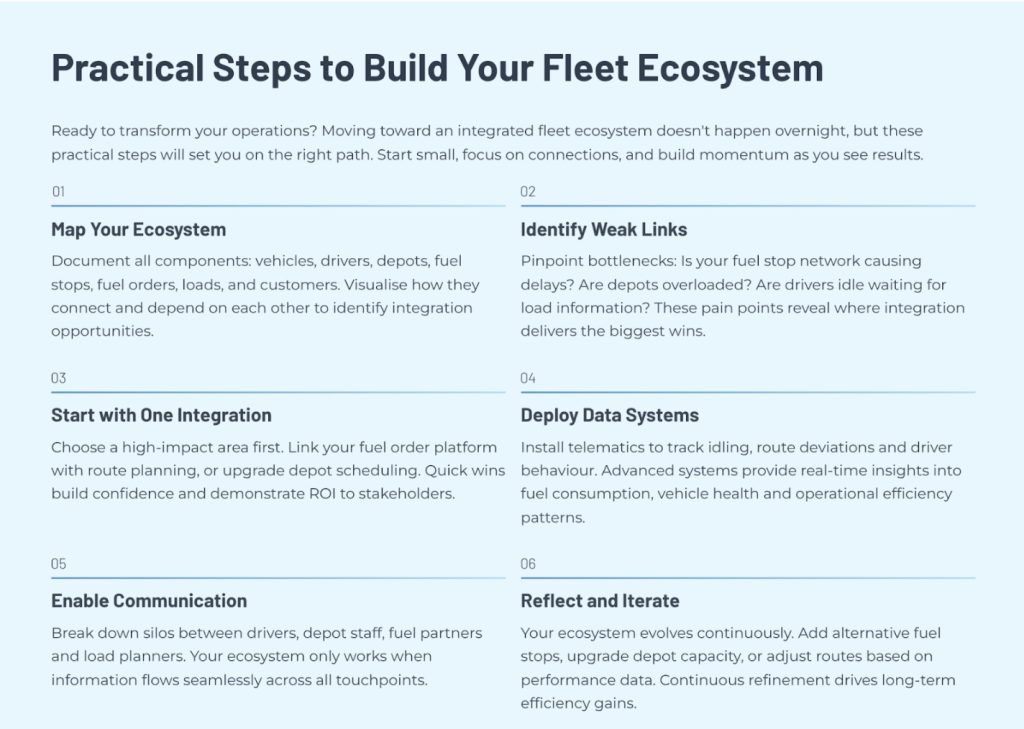
Alright, you’re convinced (or at least, interested). What can you do? Here are some steps:
- Map your ecosystem: list out all the components (vehicles, drivers, depots, fuel stops, fuel orders, loads, customers). See how they relate.
- Identify weak links: is your fuel stop network causing delays? Are your depots overloaded? Are drivers waiting because load info is late?
- Choose one integration area first: maybe you link your fuel card/refuelling platform with route planning. Or you upgrade depot scheduling.
- Use data: install telematics, track idling, route deviations, driver behaviour. Some studies note that advanced telematics gives insight into fuel use, driver behaviour and vehicle health.
- Communicate across all parts: your drivers, depot staff, fuel partners, load planners must talk. The ecosystem works only when information flows.
- Reflect and iterate: the ecosystem isn’t static. Maybe you add alternative fuel stops, maybe you upgrade a depot, maybe you adjust routes. Keep refining.
Time to shift mindset
At TFN, we understand that managing a fleet isn’t just about keeping trucks on the road, it’s about keeping the entire operation moving as one. That’s why our ecosystem connects every part of your business: from refuelling and route planning to bulk fuel supply, depot visibility and driver management.
Through one integrated platform, you can monitor every refuel, plan efficient routes, manage overnight stops and track performance in real time. No more juggling between suppliers, systems and spreadsheets, just one connected network that helps you refuel smarter, reduce downtime and strengthen relationships across your operations.
So, instead of managing trucks in isolation, manage the entire journey with TFN, the modern fuel ecosystem built for transporters who see beyond the road ahead.
One Solution. Endless Possibilities.
Resources
- https://www.moneyweb.co.za/news/south-africa/petrol-price-drops-in-august-but-diesel-climbs/#:~:text=According%20to%20a%20statement%20issued,up%2063%20cents%20per%20litre
- https://iol.co.za/news/south-africa/2025-05-22-the-poor-will-be-hit-hardest-treasury-slammed-for-increasing-fuel-levy-in-2025-budget-3-0/
- https://thestar.co.za/motoring/industry-news/2025-08-12-diesel-price-hiking-cycle-appears-to-be-over-with-relief-expected-in-september/
- https://www.news24.com/business/economy/petrol-diesel-prices-may-be-on-track-for-cuts-next-month-20250815-0716
- https://www.thesouthafrican.com/news/heres-the-good-petrol-and-great-diesel-price-forecast-for-september-2025/